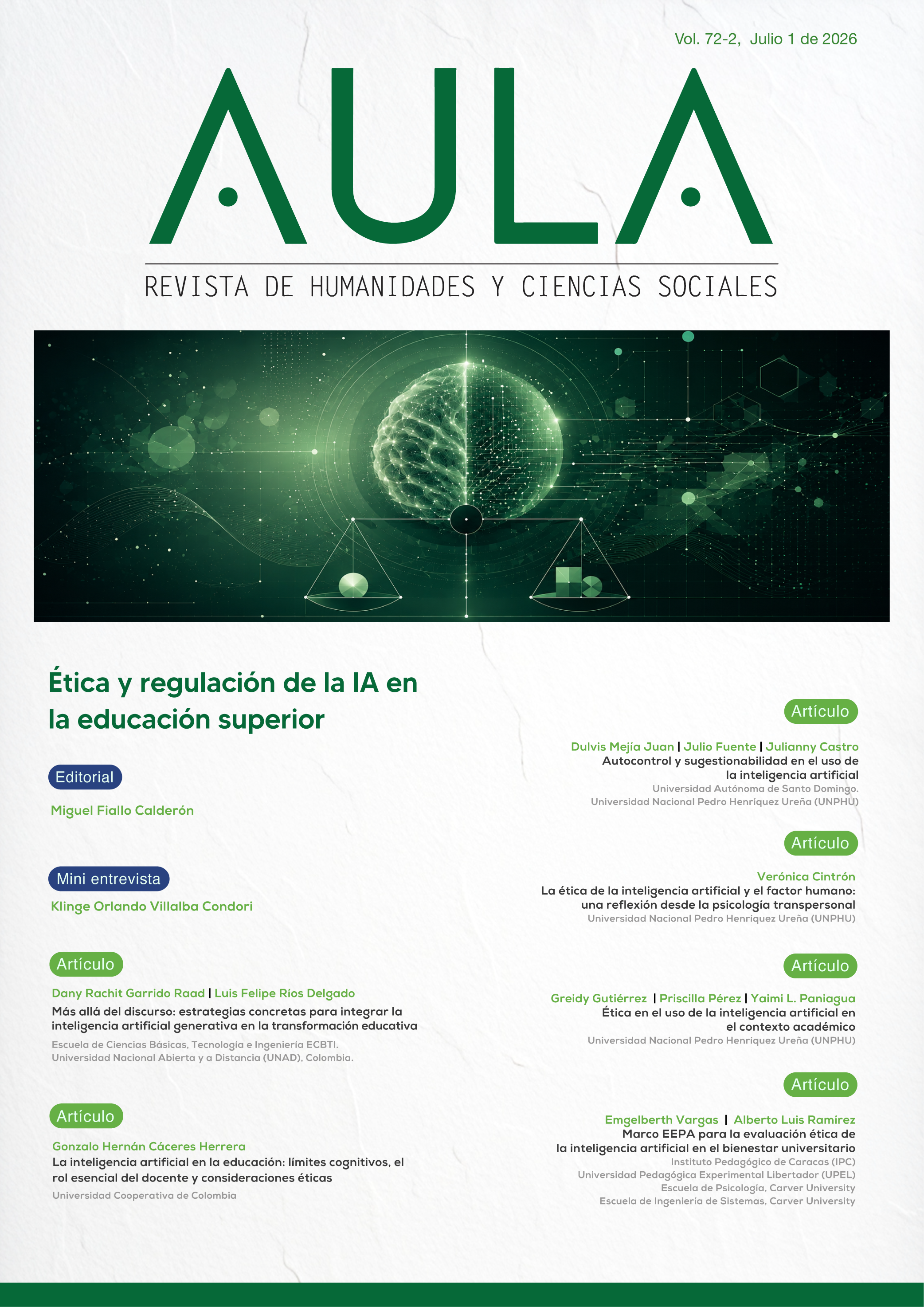
The EEPA framework for ethical evaluation of AI in university well-being
 Emgelberth Vargas
- Alberto Luis Ramírez
Published 2026-07-06 — Updated on 2026-07-07
Keywords
- Artificial intelligence in education,
- Student psychological well-being,
- AI ethics,
- Digital mental health,
- University governance
- Algorithmic dependency ...More
Copyright (c) 2026 AULA Revista de Humanidades y Ciencias Sociales

This work is licensed under a Creative Commons Attribution 4.0 International License.
How to Cite
Abstract
The incorporation of artificial intelligence (AI) systems into the emotional and psychological support of university students has turned a technical problem into a first-order ethical concern. Drawing on a critical review and documentary analysis of specialized literature published between 2019 and 2025, this article examines the relationship between algorithmic mediation of psychological well-being and the subjective experience of adolescents in higher education.
The study adopts a documentary analytical review design (Fink, 2019; Grant & Booth, 2009), drawing on 37 primary sources retrieved from Scopus, PsycINFO, ERIC, and Web of Science, supplemented by grey literature searches in Google Scholar. The review period spans specialized literature published between 2019 and 2025.
The analysis identifies three tensions that structure the contemporary debate, though not with equal weight. The most discussed, and paradoxically the most poorly framed, concerns the partial efficacy of AI systems against their constitutive empathic limitations. The second, less visible but equally urgent, is the risk that democratizing access narratives may conceal processes of commodification of student distress. The third, and in the authors' view the most underestimated in the recent literature, is the possibility that intensive use of these tools erodes, rather than strengthens, the psychological autonomy of the student as a subject in formation. The findings indicate that available evidence shows positive effects limited to mild symptoms over the short term, while risks of algorithmic dependency, commodification of emotional data, and institutional disengagement remain systematically underestimated. In response, the article proposes the EEPA framework, Efficacy, Equity, Privacy, and Autonomy, as an analytical instrument for the critical evaluation of AI systems oriented toward student well-being. It concludes that the ethical legitimacy of these tools depends on specific institutional, pedagogical, and regulatory conditions, the construction of which is an urgent responsibility of higher education.
References
- American College Health Association. (2023). ACHA guidelines on artificial intelligence in student mental health services. https://www.acha.org/ACHA/Resources/Topics/Mental_Health.aspx
- Arnett, J. J. (2000). Emerging adulthood: A theory of development from the late teens through the twenties. American Psychologist, 55(5), 469–480. https://doi.org/10.1037/0003-066X.55.5.469
- Barraza-Macías, A. (2022). Ansiedad académica en universitarios latinoamericanos: Una revisión sistemática. Revista de Psicología Educativa, 10(2), 45–63. https://doi.org/10.20511/pyr2022.v10n2.1654
- Baumel, A., Muench, F., Edan, S., & Kane, J. M. (2019). Objective user engagement with mental health apps: Systematic search and panel-based usage analysis. Journal of Medical Internet Research, 21(9), e14567. https://doi.org/10.2196/14567
- Beauchamp, T. L., & Childress, J. F. (2019). Principles of biomedical ethics (8th ed.). Oxford University Press.
- Bermúdez-Díaz, L., y Villanueva-Hernández, C. (2021). Estrés académico y salud mental en estudiantes universitarios de América Latina. Salud Mental, 44(3), 123–132. https://doi.org/10.17711/SM.0185-3325.2021.016
- Bickmore, T. W., Trinh, H., Asadi, R., & Olafsson, S. (2018). Safety first: Conversational agents for health communication. In Proceedings of the 2018 ACM International Conference on Intelligent Virtual Agents (pp. 2–9). ACM. https://doi.org/10.1145/3267851.3267881
- Billieux, J., Maurage, P., Lopez-Fernandez, O., Kuss, D. J., & Griffiths, M. D. (2015). Can disordered mobile phone use be considered a behavioral addiction? An update on current evidence and a comprehensive model for future research. Current Addiction Reports, 2(2), 156–162. https://doi.org/10.1007/s40429-015-0054-y
- Carr, N. (2010). The shallows: What the Internet is doing to our brains. W. W. Norton & Company.
- Choukas-Bradley, S., Maheux, A. J., Goldberg, M. H., Rouleau, C. R., & Roberts, S. R. (2022). Picture perfect during a pandemic: A study of adolescent social media use and well-being. Frontiers in Psychology, 13, 856763. https://doi.org/10.3389/fpsyg.2022.856763
- Cushman, P. (2011). Toward a sociohistorical understanding of constructivism. Journal of Constructivist Psychology, 24(1), 1–16. https://doi.org/10.1080/10720537.2011.535554
- Facer, K. (2011). Learning futures: Education, technology and social change. Routledge.
- Fernández-Berrocal, P., Extremera, N., & Ruiz-Aranda, D. (2021). Emotional intelligence and mental health in university students: A systematic review. Psicothema, 33(2), 161–170. https://doi.org/10.7334/psicothema2020.356
- Fink, A. (2019). Conducting research literature reviews: From the Internet to paper (5th ed.). SAGE.
- Fitzpatrick, K. K., Darcy, A., & Vierhile, M. (2017). Delivering cognitive behavior therapy to young adults with symptoms of depression and anxiety using a fully automated conversational agent (Woebot): A randomized controlled trial. JMIR Mental Health, 4(2), e19. https://doi.org/10.2196/mental.7785
- Freire, P. (2005). Pedagogía del oprimido (3.ª ed.). Siglo XXI Editores.
- Fricker, M. (2007). Epistemic injustice: Power and the ethics of knowing. Oxford University Press.
- Giroux, H. A. (2011). On critical pedagogy. Continuum.
- Grant, M. J., & Booth, A. (2009). A typology of reviews: An analysis of 14 review types and associated methodologies. Health Information & Libraries Journal, 26(2), 91–108. https://doi.org/10.1111/j.1471-1842.2009.00848.x
- Gross, J. J. (2015). Emotion regulation: Current status and future prospects. Psychological Inquiry, 26(1), 1–26. https://doi.org/10.1080/1047840X.2014.940781
- Holmes, W., Porayska-Pomsta, K., Holstein, K., Sutherland, E., Baker, T., Buckingham Shum, S., & Koedinger, K. R. (2022). Ethics of AI in education: Towards a community-wide framework. International Journal of Artificial Intelligence in Education, 32, 504–526. https://doi.org/10.1007/s40593-021-00239-1
- Hooks, B. (1994). Teaching to transgress: Education as the practice of freedom. Routledge.
- Illich, I. (1971). Deschooling society. Harper & Row.
- Inkster, B., Sarda, S., & Subramanian, V. (2018). An empathy-driven, conversational artificial intelligence agent (Wysa) for digital mental well-being: Real-world data evaluation mixed-methods study. JMIR mHealth and uHealth, 6(11), e12106. https://doi.org/10.2196/12106
- Kuss, D. J., & Griffiths, M. D. (2017). Social networking sites and addiction: Ten lessons learned. International Journal of Environmental Research and Public Health, 14(3), 311. https://doi.org/10.3390/ijerph14030311
- Linardon, J., Cuijpers, P., Carlbring, P., Messer, M., & Fuller-Tyszkiewicz, M. (2021). The efficacy of app-supported smartphone interventions for mental health problems: A meta-analysis of randomized controlled trials. World Psychiatry, 18(3), 325–336. https://doi.org/10.1002/wps.20673
- Luger, E., & Sellen, A. (2016). “Like having a really bad PA”: The gulf between user expectation and experience of conversational agents. In Proceedings of the 2016 CHI Conference on Human Factors in Computing Systems (pp. 5286–5297). ACM. https://doi.org/10.1145/2858036.2858288
- Ly, K. H., Ly, A. M., & Andersson, G. (2017). A fully automated conversational agent for promoting mental well-being: A pilot RCT using mixed methods. Internet Interventions, 10, 39–46. https://doi.org/10.1016/j.invent.2017.10.002
- Matos, L., Reyes, C., y Castellanos, M. (2022). Primera generación universitaria y bienestar psicológico en contextos latinoamericanos. Revista Latinoamericana de Psicología, 54, 112–121. https://doi.org/10.14349/rlp.2022.v54.13
- Montero-Marín, J., Allwood, M., Ball, S., Crane, C., Austin, T., & Kuyken, W. (2022). School-based mindfulness training in early adolescence: What works, for whom and how in the MYRIAD trial? Evidence-Based Mental Health, 25(3), 117–124. https://doi.org/10.1136/ebmental-2022-300439
- Muñoz, R. F., Chavira, D. A., Himle, J. A., & Ho, J. (2022). Technology-based mental health interventions for Latinos: Current status and future directions. Psychiatric Services, 73(7), 799–806. https://doi.org/10.1176/appi.ps.202100096
- Norcross, J. C., & Wampold, B. E. (2019). Evidence-based psychotherapy responsiveness: The third task force report. Journal of Clinical Psychology, 75(11), 1899–1906. https://doi.org/10.1002/jclp.22893
- Odgers, C. L., & Jensen, M. R. (2020). Annual research review: Adolescent mental health in the digital age: Facts, fears, and future directions. Journal of Child Psychology and Psychiatry, 61(3), 336–348. https://doi.org/10.1111/jcpp.13190
- Oxford Internet Institute. (2023). Responsible AI for student well-being: Principles and governance. University of Oxford. https://www.oii.ox.ac.uk/research/responsible-ai-governance/
- Prinsloo, P., & Slade, S. (2017). An elephant in the learning analytics room: The obligation to act. In Proceedings of the Seventh International Learning Analytics & Knowledge Conference (pp. 46–55). ACM. https://doi.org/10.1145/3027385.3027406
- Ryff, C. D. (1989). Happiness is everything, or is it? Explorations on the meaning of psychological well-being. Journal of Personality and Social Psychology, 57(6), 1069–1081. https://doi.org/10.1037/0022-3514.57.6.1069
- Selwyn, N. (2019). Should robots replace teachers? AI and the future of education. Polity Press.
- Selwyn, N., & Hillman, T. (2022). Algorithms and the governance of educational data. Learning, Media and Technology, 47(2), 159–163. https://doi.org/10.1080/17439884.2022.2037792
- Stanford HAI. (2023). AI and student well-being: Principles for responsible integration in higher education. Stanford Human-Centered Artificial Intelligence. https://hai.stanford.edu/news/ai-student-wellbeing
- Stade, E. C., Stirman, S. W., Ungar, L. H., Boland, C. L., Schwartz, H. A., Yaden, D. B., & Eichstaedt, J. C. (2024). Large language models could change the future of behavioral health research and practice. NPJ Mental Health Research, 3, 12. https://doi.org/10.1038/s44184-024-00056-z
- Thompson, R. A. (2014). Stress and child development. The Future of Children, 24(1), 41–59. https://doi.org/10.1353/foc.2014.0004
- Torous, J., Bucci, S., Bell, I. H., Kessing, L. V., Faurholt-Jepsen, M., Whelan, P., & Firth, J. (2021). The growing field of digital psychiatry: Current evidence and the future of apps, social media, sensing, and artificial intelligence. World Psychiatry, 20(3), 318–335. https://doi.org/10.1002/wps.20883
- Turkle, S. (2011). Alone together: Why we expect more from technology and less from each other. Basic Books.
- Turkle, S. (2015). Reclaiming conversation: The power of talk in a digital age. Penguin Press.
- Twenge, J. M. (2017). iGen: Why today’s super-connected kids are growing up less rebellious, more tolerant, less happy, and completely unprepared for adulthood. Atria Books.
- Wampold, B. E. (2015). How important are the common factors in psychotherapy? An update. World Psychiatry, 14(3), 270–277. https://doi.org/10.1002/wps.20238
- Weizenbaum, J. (1966). ELIZA—A computer program for the study of natural language communication between man and machine. Communications of the ACM, 9(1), 36–45. https://doi.org/10.1145/365153.365168
- Williamson, B., & Eynon, R. (2020). Historical threads, missing links, and future directions in AI in education. Learning, Media and Technology, 45(3), 223–235. https://doi.org/10.1080/17439884.2020.1798995
- Williamson, B., Gulson, K. N., Perrotta, C., & Witzenberger, K. (2022). AI and datafication of schooling. Learning, Media and Technology, 47(2), 157–158. https://doi.org/10.1080/17439884.2022.2062196
- Woebot Health. (2021). Real-world evidence: Woebot outcomes and impact. https://woebothealth.com/real-world-evidence
- Organización Mundial de la Salud. (2022). Salud mental de los adolescentes. https://www.who.int/es/news-room/fact-sheets/detail/adolescent-mental-health
- Zuboff, S. (2019). The age of surveillance capitalism: The fight for a human future at the new frontier of power. PublicAffairs.