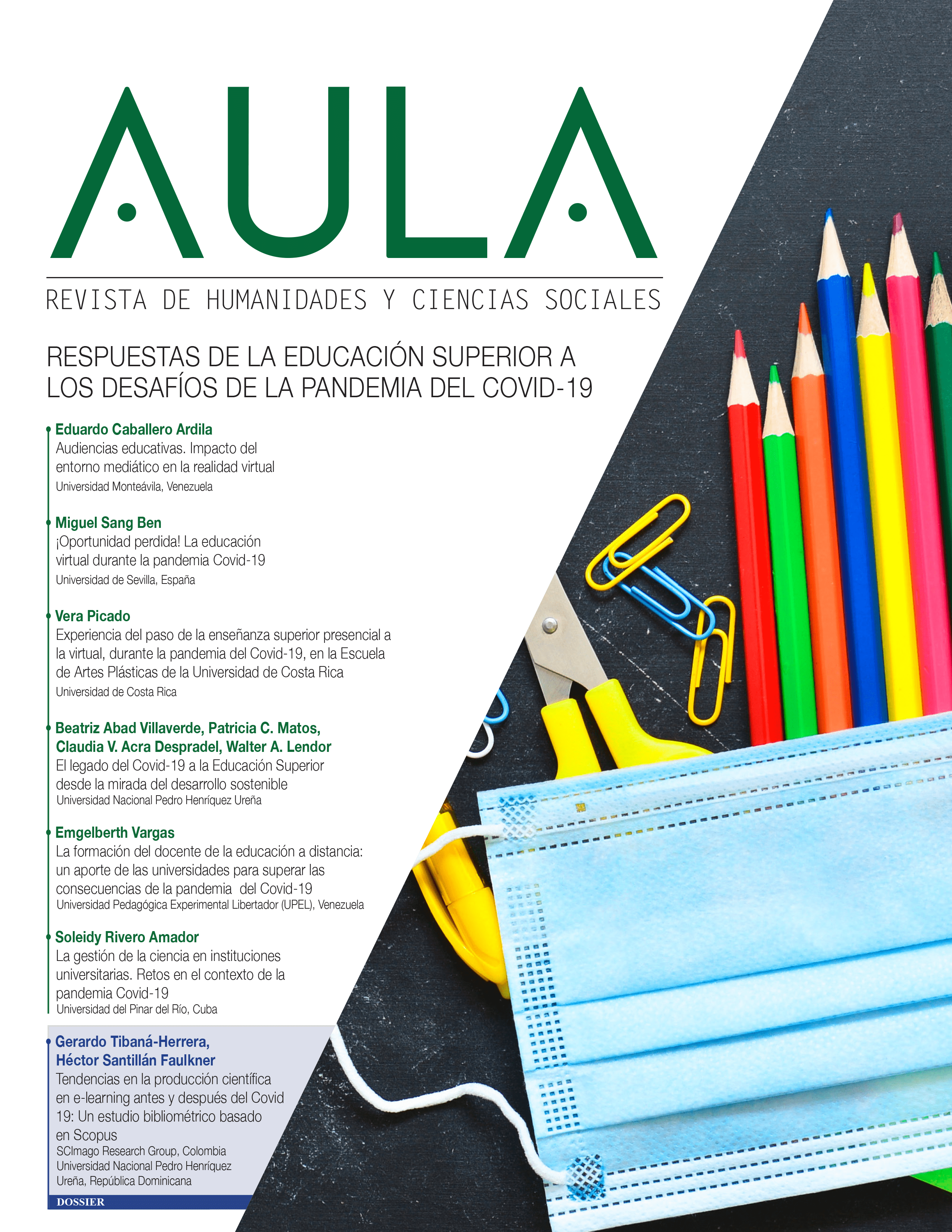
El legado del Covid-19 a la educación superior desde la mirada del desarrollo sostenible
 Patricia Carolina Matos Lluberes
- Claudia Virginia Acra Despradel
- Walter Alberto Lendor Cabrera
Published 2022-07-02 — Updated on 2023-06-01
Versions
- 2023-06-01 (2)
- 2022-07-02 (1)
Keywords
- Higher education,
- Sustainable development,
- Covid-19,
- Pandemic,
- Postpandemic
Copyright (c) 2022 AULA Revista de Humanidades y Ciencias Sociales

This work is licensed under a Creative Commons Attribution 4.0 International License.
How to Cite
Abstract
The 2030 Agenda for Sustainable Development is a declaration of principles that advocates the end of inequalities and the protection of society and the environment. However, meeting the proposed goals is a challenge for all nations, especially for developing countries, where vulnerability is greater and resources are scarce. Covid-19 was not only a tragedy for humanity and the planet, but also served to further accentuate weaknesses and slow progress towards the Sustainable Development Goals. During the confinement and post-pandemic periods, institutions of higher education were able not only to withstand the harsh impact of Covid-19 but also contributed in a significant way to combating it by offering solutions that helped preserve the health of the population and transform work systems to safeguard the economy. This paper addresses the difficulties that higher education went through during the pandemic and its impact on the fulfillment of the 2030 Agenda, to go on to give an account of how, despite the difficulties. They were able to generate solutions from each of their substantive functions, helping recovery and transformation towards a more sustainable world.
References
- Banco Interamericano de Desarrollo (BDI). (2020). La educación superior en tiempos de COVID-19. Aportes de la Segunda Reunión del Diálogo Virtual con Rectores de Universidades Lideres de América Latina.
- Cosme, L. J. (2018). Los Objetivos de Desarrollo Sostenible y la academia The Objectives of Sustainable Development and the academy. In MEDISAN (Vol. 22, Issue 8).
- Cruz, F. L., y Serrano, D. E. (2020). El desarrollo sustentable y las Instituciones de Educación Superior ante el Covid-19. In J. Gasca y H. E. Hoffmann (Eds.), Factores críticos y estratégicos en la interacción territorial: Desafíos actuales y escenarios futuros: Vol. IV. http://ru.iiec.unam.mx/5235/
- Diaz, J. A., y Valdes, M. L. (2017). Fundamentos teóricos metodológicos para el diseño de ambientes de aprendizaje en la Educación Médica Superior Cubana. Medisur, 15(6). http://www.medisur.sld.cu/index.php/medisur/article/view/3817
- Escudero-Nahón, A. (2021). Metasíntesis sobre la narrativa educativa durante la pandemia por COVID-19. Diálogos Sobre Educación, 0(22). https://doi.org/10.32870/DSE.V0I22.849
- García-Arce, J. G., Pérez- Ramírez, C. A., y Gutiérrez, B. E. (2021). Objetivos de Desarrollo Sustentable y funciones sustantivas en las Instituciones de Educación Superior. Actualidades Investigativas En Educación, 21(3), 1–34. https://doi.org/10.15517/aie.v21i3.48160
- Kurjak, A. (2016). How to Improve Visibility of Scientific Biomedical Sources. ACTA INFORM MED, 24(6), 413–415.
- Mawonde, A., y Togo, M. (2019). Implementation of SDGs at the University of South Africa. International Journal of Sustainability in Higher Education, 20(5), 932–950. https://doi.org/10.1108/IJSHE-04-2019-0156/FULL/XML
- Nilsson, M., Chisholm, E., Griggs, D., Howden-Chapman, et all.(2018). Mapping interactions between the sustainable development goals: lessons learned and ways forward. Sustainability Science, 13(6), 1489–1503. https://doi.org/10.1007/S11625-018-0604-Z/TABLES/2
- Quintero, J. A. (2021). COVID-19: su impacto en la educación superior y en los ODS – UNESCO-IESALC. IESALC-UNESCO. https://www.iesalc.unesco.org/2021/06/01/covid-19-su-impacto-en-la-educacion-superior-y-en-los-ods/
- Ramírez-Montoya, M. S. (2021). Obsolescencia del conocimiento vs formación para el desarrollo sostenible: Voces de protagonistas en el marco de la Covid-19. Texto Libre: Linguagem e Tecnología, 14(2). https://doi.org/10.35699/1983-3652.2021.33840
- Sanabria-Suárez, A. C., Forero Orozco, Á. M., Rojas Sabogal, A. L. et all (2020). Evaluación de las capacidades académicas de las instituciones de educación superior frente a los Objetivos de Desarrollo Sostenible: una propuesta metodológica. Desarrollo y Sociedad, 2020(86), 133–190. https://doi.org/10.13043/DYS.86.5
- Schwendimann, B. A., Kappeler, G., Mauroux, L., y Gurtner, J. L. (2018). What makes an online learning journal powerful for VET? Distinguishing productive usage patterns and effective learning strategies. Empirical Research in Vocational Education and Training, 10(1), 1–20. https://doi.org/10.1186/S40461-018-0070-Y/TABLES/5
- UN General Assembly. (2015). Transforming our world: the 2030 Agenda for Sustainable Development Transforming our world: the 2030 Agenda for Sustainable Development Preamble. http://goo.gl/rgzQUp
- UNESCO-IESALC. (1998). Conferencia Mundial sobre la Educación Superior.
- UNESCO-IESLAC. (2020). Covid-19 y educación superior: de los efectos inmediatos al día después.
- Vilalta, J. M., Betts, A., y Gómez, V. (2018). Sustainable Development Goals: Actors and Implementation A Report from the International Conference Higher Education’s Role in the 2030 Agenda: The Why and How of GUNi’s Commitment to the SDGs Introduction: the SDG Framework. A Report from the International Conference, 10–14. http://www.iiep.unesco.org/en/three-challenges-higher-educa-
- Vincenzi, R. (2020). Gobernanza 4.0 en la educación superior. Debate Universitario, 8(16), 15–26.
- Zagami, J., Bocconi, S., Starkey, L., et all.(2018). Creating Future Ready Information Technology Policy for National Education Systems. Technology, Knowledge and Learning, 23(3), 495–506. https://doi.org/10.1007/S10758-018-9387-7/FIGURES/1